2. Profile: side plane and jaw#
Goal: draw a head from the side, using the same ball and thirds as Lesson 1, plus the side plane, the ear and the jaw.
The side view shows two things the front view hides: how deep the head is, and where the ear and jaw sit. Lesson 3 combines both views to turn the head.
Step by step#
Step through the construction at your own pace. Draw each line on your own paper before tapping Next.
You need#
- HB or 2B pencil
- Copier paper
- A timer
- A mirror, or a photo of someone in profile, for the last drill
Diagram#
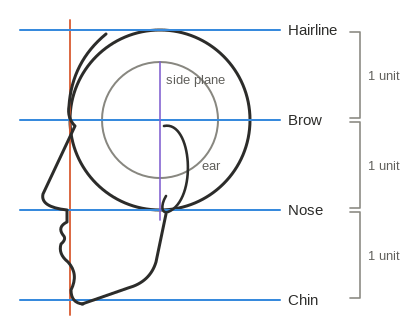
Steps#
- Draw the ball. Same as Lesson 1. Decide now which way the face looks; start with left.
- Draw the side plane. A smaller circle inside the ball, about two-thirds of its width. In a side view you are looking straight at the flat side of the skull.
- Brow line. Horizontal, through the middle of the ball, carried forward past the front edge.
- Face line. A vertical line just touching the front of the ball. The forehead, nose and chin are built against it.
- Hairline. Near the top of the ball. Hairline to brow is your unit, the same as Lesson 1.
- Nose and chin. Measure one unit down for the base of the nose, one more for the chin. The thirds don't change when the head turns.
- Ear. Draw a line down through the centre of the side plane. The ear sits just behind it, top level with the brow, bottom level with the nose.
- Jaw. From just under the ear, down to the jaw corner at about mouth level, then forward along the jawline to the chin.
- Profile. Forehead curving down to a small bump at the brow, the nose as a wedge reaching out to the nose line, the lips, then the chin, which sits close to the face line.
Check: the head should be almost as deep (front to back) as it is tall from hairline to chin.
Drill#
- Warm-up, 5 minutes: 10 balls with side planes, one stroke each.
- Main drill: 10 profile heads facing left, then 10 facing right. Under 2 minutes each, construction plus a simple profile line. Facing right feels harder for right-handers; that's normal.
- Then: one profile from a photo or a mirror, using the construction underneath.
Common mistakes#
- The ear is too far forward. It belongs behind the centre of the side plane, roughly in the middle of the whole head, not near the cheek.
- The back of the head is cut off. People draw a flat face with a thin skull behind it. The ball sets the depth; keep all of it.
- The jaw starts in front of the ear. The jaw hinges just under the ear. Starting it further forward gives a weak, tiny jaw.
- The chin is too short. The same mistake as Lesson 1, and it comes back in profile. Measure the third unit.
- The nose points down too steeply. Its base sits on the nose line; the tip sticks out in front of the face line.
Checkpoint#
You are ready for Lesson 3 when:
- You can draw 10 profile heads facing each way, each under 2 minutes
- The ear sits behind the centre line, between the brow and nose lines, every time
- The three thirds match the front view from Lesson 1
Kids' track#
Shadow portraits. A side view is just a shadow shape.
- In a darkish room, tape a sheet of paper to the wall.
- Ask a grown-up to sit sideways next to it.
- Shine a torch at their head so their side shadow lands on the paper.
- Carefully trace around the shadow with a pencil.
- Now spot the parts: the bump of the forehead, the nose sticking out, the lips, the chin.
- Swap: let them trace your shadow too!
Fun check: where is the ear in your shadow tracing? Ears don't show in shadows. Draw one in: about halfway back across the head, level between the eyebrows and the bottom of the nose.
Video#
Coming soon.