4. Big planes#
Goal: see the head as a set of flat planes, and shade them with three values from one light.
Lessons 1–3 gave you the shape of the head. Planes tell you which way each part of it faces, and that is what light depends on. They are also the fracture lines for the cubist work in Module E.
Step by step#
Build the head out of planes, one group at a time. Draw each group on your own paper before tapping Next.
You need#
- HB and 4B pencils
- Copier paper
- A timer
- A lamp or torch, and an egg or a small box (optional)
- An Asaro head, if you have one: the best possible reference for this lesson
Diagram#
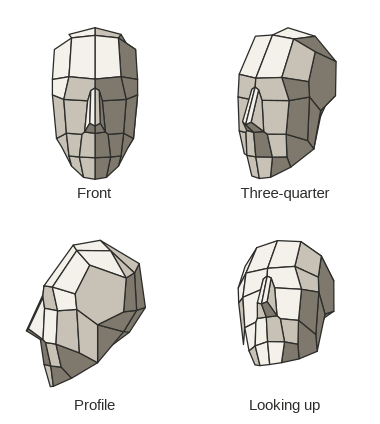
Turn the planes head, and switch the light on and off.
Steps#
- Cranium. Draw the ball, then flatten it: a top plane, the flat side plane, and the back. Think of a box with bevelled corners.
- Forehead. A broad front plane split by the centre line, turning a corner into a temple plane on each side.
- Eye sockets. One plane on each side, tucked under the brow line and angled down and inwards.
- Nose. A wedge: a narrow top plane, two side planes, and a base plane that faces down.
- Cheeks. A front plane under each eye socket, turning a sharp corner into the cheek's side plane. That corner is the cheekbone.
- Muzzle. The barrel of the mouth: a front plane and two side planes, from under the nose to above the chin.
- Jaw and chin. The chin box, the jaw's side planes back to the jaw corner, and the plane underneath.
- Light. Choose one light, top left. Give every plane one of three values: light if it faces the light, mid if it turns away, dark if it faces away. No blending.
Drill#
- Warm-up, 5 minutes: copy the planes head from the turntable at three angles, outlines only.
- Main drill: 6 plane heads (two front, two three-quarter, two looking up or down), each shaded in three flat values with the 4B. Under 5 minutes each.
- Then: pick one shaded plane head and redraw it with the light from the right. Which planes swap value?
Common mistakes#
- Too many planes. At this stage, fewer and bigger is better. Small planes come in Module B.
- Blending. Three flat values, hard edges. Smooth shading hides the planes you're trying to learn.
- Values that don't follow one light. Check every plane: which way does it face, and is that towards the light or away?
- Missing the cheekbone corner. The turn from the front of the cheek to its side is the most important edge on the face. Make it clear.
- A flat nose. Its base plane faces down and almost always sits in shadow, even when the top is lit.
Checkpoint#
You are ready for Module B when:
- You can draw a plane head from memory at front and three-quarter views
- Every plane in your shaded drawings takes one of three values from one light
- The cheekbone corner and the base of the nose read clearly
Kids' track#
Box heads. A box is a head made of big flat planes.
- Find a small cardboard box (a cereal box or tissue box works).
- Draw a face on one side with a felt-tip: eyes, nose, mouth.
- Turn the lights down and shine a torch on the box from the top left.
- Look: one side is bright, one side is in-between, one side is dark.
- Draw the box head on paper and colour the three sides: light, middle, dark.
- Move the torch to the other side. What changes?
Fun check: shine the torch at a grown-up's face from the top left. Which side of their nose is dark?
Video#
Coming soon.