17. Fracture lines along the planes#
Goal: break a portrait into a few large planes using fracture lines that follow the real planes of the face.
Random lines make random shapes. Fracture lines that run along real plane changes, the side of the nose, the cheekbone, the jaw, keep the face readable however broken it gets.
Step by step#
Step through it at your own pace. Draw each step on your own paper before tapping Next.
You need#
- HB pencil and a ruler
- Tracing paper, or a drawing app with layers
- One of your earlier portraits
Diagram#
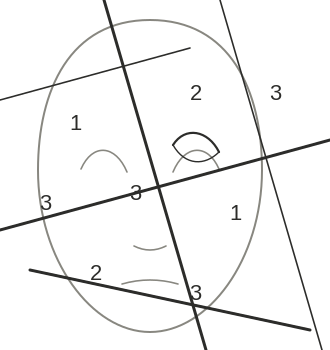
Steps#
- Start from a portrait line drawing.
- Fracture 1 down the side of the nose, carried right through.
- Fracture 2 along the cheekbone corner.
- Fracture 3 along the jaw.
- Echo the same angles in the background.
- Shift one piece across a line, as if seen from a second angle.
- Value plan: number every shape 1, 2 or 3; neighbours differ.
Keep it to 3–5 fracture lines. More than that and the face disappears.
Drill#
- Warm-up, 5 minutes: trace 3 portraits, adding only the three main fractures.
- Main drill: 3 fractured portraits with background echoes and value plans. Under 20 minutes each.
- Then: shade one in three values following its plan.
Common mistakes#
- Too many lines. 3–5 fractures. The face must still read.
- Lines that ignore the planes. Run them along real plane changes from Lesson 4.
- Fractures stopping at the head. Carry them into the background so it's one composition.
- Neighbours with the same value. Shapes merge. Change one.
- Shifting everything. One or two shifts are enough to suggest a second view.
Checkpoint#
You are ready for Lesson 18 when:
- Your fracture lines follow real planes
- They carry into the background
- Your value plan never puts the same value side by side
Kids' track#
Ruler lines. Break your picture into a puzzle.
- Draw a big face, or use your mirror self-portrait.
- With a ruler, draw 4 straight lines right across the page, through the face.
- Now you have lots of shapes. Colour each shape a different colour.
- Make neighbours different: no two touching shapes the same colour!
Fun check: turn your picture upside down. Does it look like stained glass?
Video#
Coming soon.